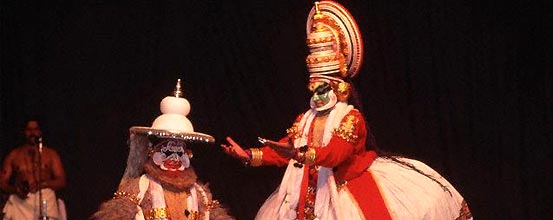
|
Dance

To an Indian artist, all arts are manifestation
of beauty. Beauty has always been Truth and Divine. The Supreme Being
has throughout been regarded as a lover of beauty and therefore, the aim
of all forms of art in India is to attain fulfillment through 'Anand'(bliss).
Accordingly, art forms in this country have been associated with Divine
worship; inspiration always is Bhakti - Devotion to God.
Scholars argue that Natya Sastra was first taught
by Lord Brahma to Bharat Maharshi. Few others say that Lord Shiva taught Natya
Sastra to Nandi Keswar who in turn taught it to Bharat Muni. Nandikeswar is
otherwise called "Tandu". Hence the primary dance of Lord Shiva is
Tandav - The cosmic dance, dance of creation as well as of destruction. It is
the dance packed with dynamic expression of power of Divine Purusha. Lord Shiva
is therefore, The Nataraj - the Cosmic Dancer. His `concert' Parvati taught
dance to other ladies of heaven but it was much subdued, gentle and pleasant.
It is "Lasya" different from Tandav.
Bharata's treatise on dramaturgy written in 3rd
Century B.C. is The Natya Sastra. The themes of the Natya are usually taken
from the ancient myths, legends and literature. As dance is the primeval expression
of man, the dancer seeks to express the emotions through body movements which
are regulated by `Tala' and `Laya' or rhythm.
The background music guides each movement of leg, arms, neck, head of the dancer.
The hands with the fingers have symbolic movements conveying meanings are called
`Mudras'. Thus, the swirling of colours, glittering ornaments, fluid movements
with beat of the drums make Indian Dance enjoyable and of visual appeal. Classical
dance rules of 2nd century B.C. divides the dance, in three specific frames
namely `Nritta" (Pure dance); `Nritya' (Emotional expression) and `Natya'
(Drama).

Thus, according to Bharat Muni, dancing is a part of the drama where the classical
dancer is a story teller with descriptive power of the poet in symbolical gesture
language. Dance minus music is incomprehensible. The musicians create the melodic
build-up of the rhythms for the dancer to put the steps and perform the countless
`Abhinaya' as carved in the sculptural renderings in the temples. Originating
from the chanted hymns of the Vedas - The Sam Veda, Music evolved to express
the seasonal cycles and the rhythm of agricultural work or of harvest or of
ceremonies or worship to Gods. Raga' enriches music. A `Raga' speaks the mind
with a particular feeling, passion or emotion according to the time of the day
or season. Indian music recognises twenty-two notes and microtones in the octave.
A `raga' is created or played by use of certain notes and microtones with the
exclusion of others to suit the ambient moods of the audience. Within the fixed
frame work, unlimited scope for improvisation and there lies the experience
and expertise of the artist.
Since an Indian musician works on emotion, he has to play the notes in octave
which has definite expression and emotional value. A group of notes combine
to produce phrase to offer definite emotional expressions. It is the musician
who mixes the notes and phrases out of the experience and practices to deliver
the effects which is called `Rasa’. Indian `Ragas' - The erotic, the pathetic,
the beautific and the heroic form the main body of classical music. Many `Ragas'
are common to the two main systems of music in India - The Hindustani and The
Carnatic. Instruments that accompany the music are Sitar, Sarangi, Sarod, Santoor,
Shahnai, Flute, Tabla, Veena, Ek-Tara, Violin etc.
|