Popularly known as the desert state, Rajasthan has some excellent wildlife
retreats, including two of the finest tiger reserves of India, one situated
at Ranthambore and the second one is at Sariska. Beside the tiger there's
also a magnificent bird sanctuary at Bharatpur, famously known as Keoladeo
National Park. The biggest attraction of this avian habitat is the yearly
arrival of the Siberian Cranes, a delight for bird watchers
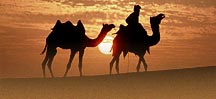
The Thar or Great Indian Desert lies predominantly in Rajasthan but spills
over as salty flatlands and grassy sprawls into Gujarat's Kutch region.
The world's most colourfully inhabited natural desert, it has at its heart
the golden city of Jaisalmer, a popular tourist destination. The Desert
National Park, an area of 3,162 sq km, is located 45 km west of this city.
Sand-dunes, both fixed and shifting, low rock-faces, grasslands and scrublands,
characterize this park where the greatest need is for water. Vast tracts
are encrusted with sewan grass, and the aak shrub and khair, khejra and
rohira trees are widespread, but sand dominates every scene. Even so, many
creatures have adapted to this harsh, inhospitable terrain. There are over
40 species of reptiles, including the burrowing Spiny-tailed Lizard, Russel's
Viper, Saw-scaled Viper and the dragon-like Common Monitor. In a realm devoid
of real fish, the Desert Skink is known as the sand-fish as it 'swims' or
burrows through sand down to a depth of 30 cm. However, birds in their large
numbers and variety are the most remarkable feature of this park. Nearly
1 20 species add colour to the dull shades of the desert.
The Indian Bustard and the wintering MacQueen's Bustard are highly, endangered
species that have benefited from the creation of the park. Flocks of sandgrouse
arrive in winter from central Asia and can be seen at more or less fixed
times in the morning at favoured waterholes. During this season, various
waterfowl and flocks of migratory Demoiselle Crane are also seen near water.
Larks, partridges, doves, bee-caters, shrikes, chats, parakeets, babblers
remain throughout the year, preyed upon by the buzzards, eagles, falcons
and kites that hover and swoop over the landscape.
The Wolf burrows into sand-dunes to shelter from the daytime heat. Other
predatory animals such as the Desert Fox, the Common Fox, the adaptable
jackal and the black-spotted Desert Cat are also shy and elusive but can
be seen at waterholes. Desert Hare and the Long-cared Hedgehog are among
the smaller denizens of the park. The strikingly beautiful Blackbuck, India's
only true antelope, and the small but graceful Chinkara (Indian Gazelle)
bound and leap amidst the sand-hills, sometimes surprisingly unafraid of
humans. All forms of life gravitate towards water. The Sudasari waterhole
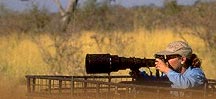
is an excellent site for observing the animals. Observation hides also offer
close encounters with desert wildlife.
Even this seemingly listless realm is beset by human demands, especially
for water. It is the world's most populated desert but, as wildlife experts
point out, the national park is a unique genetic storehouse of Indian desert
wildlife and needs only the bare minimum to flourish. The ecology of the
region would be disrupted with the artificial introduction of water.