According to the Padma (Lotus) Purana, Pushkar, 15km northwest of Ajmer, came
into existence when Lord Brahma, the Creator, dropped his lotus flower (pushpa)
to earth from his hand (kar) to kill a demon. At the three spots where the
petals landed, water magically appeared in the midst of the desert to form
three small blue lakes, and it was on the banks of the largest of these that
Brahma subsequently convened a gathering of some 900,000 celestial beings
- the entire Hindu pantheon. Surrounded by whitewashed temples and bathing
ghats, the lake is today revered as one of India's most sacred sites: Pushkaraj
Maharaj, literally "Pushkar King of Kings". During the auspicious
full-moon phase of October/ November (the anniversary of the gods' mass meeting,
or yagya), its waters are believed to cleanse the soul of all impurities,
drawing pilgrims from all over the country. Alongside this annual religious
festival, Rajasthani villagers also buy and sell livestock at what has become
the largest camel market (unt mela) in the world, when more than 200,000 dealers,
tourists and traders fill the dunes to the west of the lake.
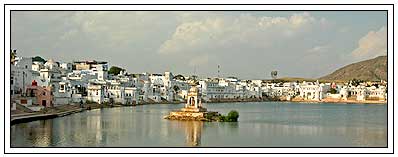
The legendary colour of the camel mela, combined with the beautiful desert
scenery and heady religious atmosphere of the temples and ghats have inevitably
made Pushkar a prime tourist destination.
History
Pushkar the sister city of Ajmer, is only 11 kms away from the city. Accounts
of this city can be founded in the 4th century writing of the Chinese traveler
Fa-Hien and also in the scripts writing during the era of Muslims invasions.
Pushkar is famous for its fairs and festivals and for Brahma Temple. It is
said that in a battle Lord Brahma killed the demon Vajra Nabh with a lotus
flower whose petals floated down to earth and landed in three places in and
Pushkar where Lakes sprang up. The bath at Pushkar is thought to be more important
than at any other place. The holy dip in this lake on Kartika Purnima is thought
to be salvation giving. Pushkar is very dear to Lord Brahma. The place is
famous in His name. So it is blessed by Him in every way. In olden times the
people who took a holy dip at Pushkar were relieved from all the sins and
went to heaven after their death by the grace of Lord Brahma. According to
another legend back in a legendary time Lord Brahma was flying over the Rajasthan
desert on his swan when some petals fell from his hand and drifted down. Miraculously,
blue lakes sprang up where the flowers had touched the soft sands. Just then,
Lord Brahma realized that this was the auspicious moment to perform a fire
sacrifice.
What to see
Pushkar Fair
A temporary township of tents springs up on the outskirts of Pushkar after
‘Deewali’, ‘the festival of lights’, in October or November
(the Indian lunar month of Kartik) as upto 200,000 people converge here for
the world-famous cattle fair – pilgrims, tourists, film makers, traders,
nomads and villagers with their herds of cattle, camels and horses. As livestock
trading spreads over a fortnight, the whole town takes on a festive carnival
atmosphere with colourful shops and food stalls coming up everywhere. While
thousands of farmers haggle over the price of a camel or cow, other villagers
participate in various contests, camel, donkey and horse races or take their
children for rides on the giant wheel.
Campfires light up the cool November evenings and the performances of folk
dance and music, cast a spell on the silent desert nights. The festivities
peak on the day of the full moon as thousands of pilgrims take a holy dip.
The moving ‘deepdan’ ceremony rounds off the proceedings, as hundreds
of tiny flickering lamps are set afloat on the serene lake.
Just be there! This is a great place for shopping for all sorts of handicrafts,
particularly embroidered fabrics, painted textiles, embroidered shoes, wall
hangings, shoulder bags and old silver jewellery.
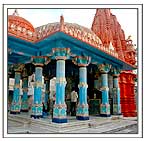
Jagatpita Shri Brahma Mandir
Pushkar's most important temple, Brahmaji Mandir, houses a four-headed image
of Brahma in its main sanctuary. A beautifully carved silver turtle sits on
the floor facing the sanctum sancotrum or "garbha griha". Peacocks
adorn the temple walls, as they are believed to be the vehicle of Goddess
Saraswati - the Goddess of wisdom and consort of Lord Brahma. Steps in a corner,
lead to a small cave dedicated to Lord Shiva.
Man Mahal
Raja Man Singh I of Amer built this royal house - the largest in Pushkar -
located on the east of the sacred Sarovar Lake in Pushkar. It affords a clear
view of the banks and temples located around the lake. It was built as a royal
guest house of Raja Man Singh I for his trips to the holy town. This traditional
guest house has now been converted into a hotel.
Warah Temple
This temple houses an image of Lord Vishnu in the incarnation of a wild boar.
The temples of Lord Brahma and Warah are considered of equal religious importance.
This ancient temple is believed to have been constructed by the Chauhan King
Anaji (1123-1150 A.D), and was renovated by Gokul Chand Parikh, a Scindia
Minister in 1806 A.D.
Getaways
Makrana
This place is renowned for the world famous Makrana marble. It was this marble,
which was extensively used in the creation of many architectural beauties
all over India. It has become a flourishing business centre of Rajasthan,
and is the biggest centre of marble trade in India. It also has some excellent
artists skilled in marble carving and it is fascinating to see these craftsmen
working on statues, vases, pedestals etc.
Nagaur
This fortified city, boasts of a chivalrous past and multi-storeyed buildings
of great architectural beauty. This is one of the most picturesque Rajput
townships, and was granted to Amar Singh Rathore by the Mughal emperor Shahjahan.
The Baradari or courtyard is painted with beautiful murals which are a fine
blend of Persian and Nagauri style. The frescoes of flowers and dancers also
grace the walls of the Baradari. Nagaur also has many old temples, mosques,
dargahs and cenotaphs.
Dining Out
All the restaurants in town are strictly vegetarian, and do not serve
even eggs. Many of the places intown offer all-you-can-eat buffet lunches
and dinners. Basically they are thalis that you serve yourself. Many times
the food is sitting all day, so it may be unhealthy. It is best to get food,
especially in India, when it is freshly cooked.
OM Siva Restaurant
Upstairs in the main bazaar, across from the State Bank of Bikaner and Jaipur,
has an all-you-can-eat breakfast. This includes cereal, fruit, brown bread
with your choice of butter, peanut butter, jelly, or cheese, and other items.
This meal is a real bargain and is recommended. The lunch buffet includes
several items including rice, vegetables, soup, chips and falafel.
There is another OM Shiva Buffet Restaurant on the rooftop of the VKTourist
Palace Hotel. It is a good place.
Raju's Garden Restaurant-In the center of the town off the main road,
is one of the better places. The spaghetti is good, and for western food this
is one of the better places. It has pizza and baked potatoes.
RS Restaurant - By the Brahma Temple, is one of the better places
in town. It has good cheap thalis.
Rainbow - Near the Brahma Temple, is a rooftop restaurant that serves
Indian, Chinese, Mexican Italian, and good falafels. It has a really good
view of the lake.
Krishna Restaurant - Temple Road has good Indian, hummus, falafel
and dosas.
Hotel Pushkar Palace - Has a good buffet and a bakery. It is well
located in a garden next to the lake.
Natraj - Near the bazaar post office, is a fairly good rooftop place.
Moondance - Has very good Indian, Italian, Mexican and Thai food.
The sizzlers are excellent. It is a popular, laid-back, chill-out place. There
is a section where you sit on the floor and eat. It is an easy place to meet
people and hangout. It is a recommended nighttime place.
Venus Restaurant - On the rooftop of the Venus Hotel, serves Indian,
Continental, Italian and Chinese food. The sizzlers are good. It is a good
place to sit and watch what is happening in the bazaar below.
The rooftop restaurant at the Oasis Hotel is good. The Sunset Café,
near the Pushkar Palace next to the lake, is a nice place to sit and watch
the sunset. The food is fairly good.
Shopping
Pushkar occupies an important place in Rajasthan as a source of souvenirs
and visitors who visit this holy town definitely go the bazaars to purchase
textiles, clothes with elaborate embroidery, ethnic jewellery which is a speciality
of Rajasthan, alluring miniature paintings, leather goods, lovely brass utensils,
mesmerising puppets and pottery. Pushkar is considered to be one of the most
interesting places in Rajasthan to buy costume jewellery and embroidered clothes.
At the time of Pushkar fair, one can purchase various items like beads, brass
utensils, lovely colourful bangles, leather goods, unique embroidered clothes,
camel cover, and much more.
Major shopping areas in Pushkar are Sarafa Bazar, Baza Bazar and Kedalganj
bazaar.
Visiting
The best time to visit Pushkar is in October/November when the city is
abuzz with activity for the Pushkar Fair.
Tourist Offices
Rajasthan Tourist Office, Hotel Sarovar, Tel: 2040.
How to get there
Air
The nearest airport is Jaipur from where one can take flights for Delhi and
Mumbai.
Rail
Ajmer is the nearest railway station from where one can take trains for the
major destination of India.
Road
Pushkar is connected to Ajmer by road which is around 14 km away. Jeeps and
taxis are also available.