Jodhpur, settled in 1459 by Rao Jodha, this city has a history of war, romance
and valor. With its imposing Mehrangarh Fort, that can be see from all parts
of the city, to its broad strees, its signature blue white houses, Jodhpur
still encompasses a bye-gone era.
Half Day Sightseeing, visit the impressive Mehrangarh Fort on a 37 m low
sandstone hill built by Rao Jodha in 1459. From the top of the fort one can
get a bird’s eye view of the old city to the Jaswant Thada, an imposing
marble cenotaph built in 1899 for Maharajah Jaswant Singh II, and smaller
memorials to other Maharajahs of Jodhpur. At the end of the tour enjoy a short
walk through the local and vibrant bazaar.
History
Jodhpur was founded by the Rajput chief Rao Jodha in 1459. The city was
the erstwhile capital of the Marwar state. A 10-km-long wall made of stone
and built about a century after the city was founded, surrounds the old city.
There are about 100 towers in the city, most of which are surrounded by defensive
battlements. It was founded in 1459 A.D. by Rao Jodha-chief of the Rathore
clan of Rajputs who claimed to be descendants of Rama - hero of the epic 'Ramayana'.
Rahores controlled a large part of Rajasthan, especially during the reigns
of Rao Udai Singh (1581 AD) and his son Raja Sur Singh ((1595), who conquered
Gujarat and a good part of Deccan for the Mughal Emperor Akbar. The Rathores
always had good relationships with the Mughals and Maharaja Jaswant Singh
(1678) supported Shahjahan in the Mughal struggle for war of succession. Only
problematic relationship they had was with Aurangzeb. After the death of Aurangzeb
in 1707, Maharaja Ajit Singh became the ruler of Jodhpur. He drove out Mughals
from Ajmer and added substantially to the Mehrangarh Fort.
What to see
Mehrangarh Fort
takes pride of place as the first destination on any visitor’s list.
From the outside its wide, high walls and sheer cliffs appear unassailable,
imposing and austere, but once inside you discover several lavishly decorated
palaces, with intricate carved ‘jalis’ and panels that take your
breath away. Seven heavily fortified gateways led to the palaces, armoury
and royal chambers. Few of these gates remain but the palaces are impressive
in their variety and ornamentation
he notable ones are
Phool Mahal (Flower Palace),
with its beautifully painted walls, Moti Mahal (Pearl Palace) with its Shringar
Chowk (coronation seat) featuring peacock armrests and gilded elephants, Sheesh
Mahal (Mirror Palace), the Sileh Khana, the Umaid Vilas and the Daulat Khana.
At the Daulat Khana, visitors get to see a rich and varied collection of royal
memorabilia, fine Rajput miniatures and Ragmala paintings.
The Mehrangarh Fort Palace Museum and the Umaid Bhawan Palace Museum
house a fine collection of royal memorabilia, armours and arms, bejewelled
howdahs, palanquins etc.
cc
a few metres below the fort, is the site of the white marble royal cenotaph
of Jaswant Singh II and four of his successors. The Mahamandir, dedicated
to Lord Shiva is an architectural wonder, built in 1812, with 84 intricately
carved pillars. As it was outside the city walls it was given its own protective
fortifications, a sign of those turbulent times!
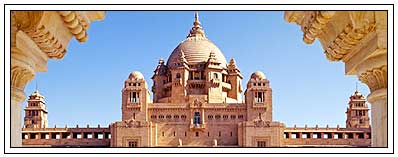
The Umaid Bhawan Palace
was built during the 1920s and '30s as a famine relief project when Maharaja
Umaid Singh started a food for work program. The palace took 16 years
to complete- no wonder, then that with its 347 rooms, it is one of the largest
private residences in the world.
The present ruler converted it into a fine luxury hotel with an in house
museum while retaining the use of one wing as the private residence of the
erstwhile royal family.
Getaways
Mandore
the former capital of Marwar lies 8 km southwest, a true oasis in the desert,
with its greenery and pretty gardens. The main attraction here is the ‘Hall
Of Heroes’, where you see sixteen huge figures of popular Hindu and folk
deities carved out of single rock.
A fascinating drive through the arid landscape past stretches of desert and
tiny hamlets bring you to Ossian (65 km northwest of Jodhpur, off the main
Jodhpur-Bikaner road). Ossian is has a cluster of Hindu and Jain temples dating
back to the 8th to 11th centuries.
Guda Bishnoi
are the picturesque villages of the Bishnoi community, 25 km from the city
limits. The Bishnois are great conservationists, who believe staunchly in
the sanctity of animal and plant life and renowned for nurturing and protecting
local flora and fauna. The Bishnois will protect wildlife at the cost of their
own lives, if necessary. As a result, herds of blackbuck and chinkara roam
freely. Go there for an interesting insight into the traditional ways of rural
India and meet some true conservationists.
Sardar Samand Lake and Palace
is the former hunting lodge and summer getaway of the erstwhile ruling family
of Jodhpur. Little Rajasthani villages and hamlets, drying fields of red chilli
peppers and herds of black buck and chinkaras enliven the 55 km drive.
Balsamand Lake
& Palace is an artificial lake/water body that is the source of freshwater
for the region. A mere 7 km from the main city, it is a picturesque picnic
spot with summer palaces along the embankment and a bird sanctuary. Both Bal
Samand and Sardar Samand have top quality accommodation for overnight stopovers
or for those who like to stay away from the hustle and bustle of city life.
Osian
About 58 km from the city, on the diversion off the main Jodhpur-Bikaner Highway,
lies Osian, an oasis in the desert. Fifteen beautifully sculptured Jain and
Brahmanical temples dot the landscape of this ancient township. Of these the
most outstanding ones are the Surya or Sun Temple, Kali temple, Sachiya Mata
Temple and the main Jain temple dedicated to Lord Mahavira.
Kailana Lake
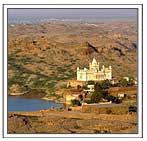
is located 8 km west of Jodhpur and was constructed in 1872 by Pratap Singh.
The beautiful lake is an ideal picnic spot and also you can enjoy bird watching.
It is spread over an 84 sq. km area. It is reputed to have spectacular sunsets.
Jaisalmer
In the remote westernmost corner of Rajasthan, 100km beyond its closest neighbourhood
Pokaran. Jaisalmer is a desert town. One of the main attractions is the Jaisalmer
Fort and the beautiful havelis which were built by wealthy merchants of Jaisalmer.
Dining Out
Jodhpur has a few reasonably priced restaurants that serve a pot pourri
of different cuisines with a la carte selection of local Rajasthani, North
and South Indian, Chinese, Continental and American dishes catering to a wide
variety of eating preferences. What the city is really famous for is a selection
of spicy savouries and the sweet lover's delight, the famous ‘mawa ki
kachori’ - a rich sweetmeat with a filling of thickened milk and dry
fruits, served dripping in syrup. Jodhpur is equally
How to get there
Air
Jodhpur is connected by flights to Delhi, Mumbai, Jaipur and Udaipur at least
thrice a week. The airport is 5 km from the city centre and auto rickshaw
or taxis are available for the ride into town. Fix the price before getting
into the auto/taxi and bargain hard! You could also have your travel agent
to get a car to meet you on arrival or have your hotel send you a pick up.
Rail
Jodhpur has direct rail connections with many important cities, notably Delhi,
Ahmedabad, Mumbai and Varanasi. The city is connected directly or indirectly
too many places in the state and to important destinations in the neighbouring
states of Gujarat and Delhi. Trains available are in the express, superfast
and mail categories.
Road
The national and state highways that connect Jodhpur to Delhi, Jaipur, Udaipur,
Ajmer and Ahmedabad are well maintained. Almost all rented cars and jeeps
in India come with a chauffeur, so if you want to see the country and the
weather is right, coming in to Jodhpur by road may be a good idea. State roadways
buses and private bus services run air-conditioned coaches and regular buses
on most routes. But the roads connecting Jodhpur to smaller destinations like
Barmer and Pokhran may not be very good. Key distances – Delhi - 597
km; Udaipur – 260 km and Jaipur – 335 km.